To access the HUNT ME referral program dashboard, enter the email and password you used during registration.
Fill out the form — it takes 2 minutes. A manager will contact you on Telegram, provide free training, and help you get your first result.
Scaling affiliate traffic without losing quality is not just about increasing the budget.
It is about understanding why the campaign was profitable in the first place.
A funnel that works at low volume often performs well because it reaches the most responsive part of the audience first. The traffic source finds users who are more likely to click, register, get approved, pay, and stay. When you increase volume, the system has to expand beyond that core audience.
That is where problems begin.
New users may be colder. New placements may be weaker. CPC may rise. Creative fatigue may appear faster. Approval rate may drop. Paid rate may decline. Refunds and chargebacks may appear later. What looked like growth can quickly become a larger version of the same campaign with worse economics.
Earn with HUNT ME — weekly payouts
That is why affiliate campaign scaling should be treated as a separate stage, not as an automatic continuation of a successful test.
The real question is not only how to scale an affiliate funnel.
The real question is how to increase affiliate traffic volume while protecting traffic quality, approval rate, paid rate, retention, and net profit.
Before increasing budget, you need more than one good day.
You need evidence that the funnel is stable.
A campaign should not be scaled only because early ROI looks positive. In many affiliate offers, especially subscription and payment-based models, revenue can be delayed. Users may pay later. Refunds and chargebacks may appear later. Approval may take time. Hold periods can change cash flow.
Before scaling, check:
One profitable day is not a scaling signal.
Earn with HUNT ME — weekly payouts
One strong paying user is not a scaling signal.
A campaign is ready to scale when the unit economics are stable enough to survive more volume.
Why traffic quality drops when scaling is easy to understand if you look at how most traffic sources deliver users.
At low spend, the algorithm or source often finds the easiest conversions first. These are the highest-intent users, the best placements, the most responsive audience segments, or the cheapest profitable pockets.
When you increase spend, the system must find additional users.
Those additional users are often less responsive.
This can lead to:
Scaling also changes the auction.
As you push for more volume, you may need to bid higher or accept broader inventory. This can increase traffic cost while reducing average user quality.
Another problem is mixing data.
When new placements, GEOs, creatives, or traffic sources are added under the same campaign, weak segments can hide inside average statistics. The campaign may still look acceptable overall while part of the budget is already unprofitable.
That is why affiliate traffic quality control must become stricter during scaling, not looser.
The biggest mistake is scaling the entire campaign at once.
Experienced affiliates scale confirmed segments.
Before increasing spend, break the funnel down by:
Find the segments that actually produce profit.
Which SubIDs have higher EPC?
Which placements deliver paid users?
Which GEOs have stable approval and paid rate?
Which creatives bring users who stay and do not refund?
Which device types perform better?
Affiliate scaling by SubID is one of the safest ways to grow because it focuses budget on proven parts of the funnel.
Instead of giving more money to the whole campaign, increase spend where the economics are already confirmed.
At the same time, cut or limit segments that generate clicks without meaningful downstream value.
This protects quality while allowing volume to grow.
Gradual affiliate campaign scaling helps protect the learning and stability of the campaign.
A sudden budget jump can change delivery behavior. For example, increasing budget by three or five times overnight may push the traffic source into weaker inventory or restart its optimization process.
A safer approach is step-by-step scaling.
A common rule is to increase budget by 20–30% at a time, then let the campaign run long enough to collect data at the new level.
After each increase, check:
Affiliate budget scaling should follow a cycle:
increase → measure → stabilize → increase again.
This is slower than an aggressive jump, but it helps prevent one impulsive budget change from destroying a working funnel.
GEO scaling affiliate marketing can be one of the strongest ways to grow, but it must be done carefully.
Different countries have different:
Do not combine very different GEOs into one campaign and judge them by one average ROI.
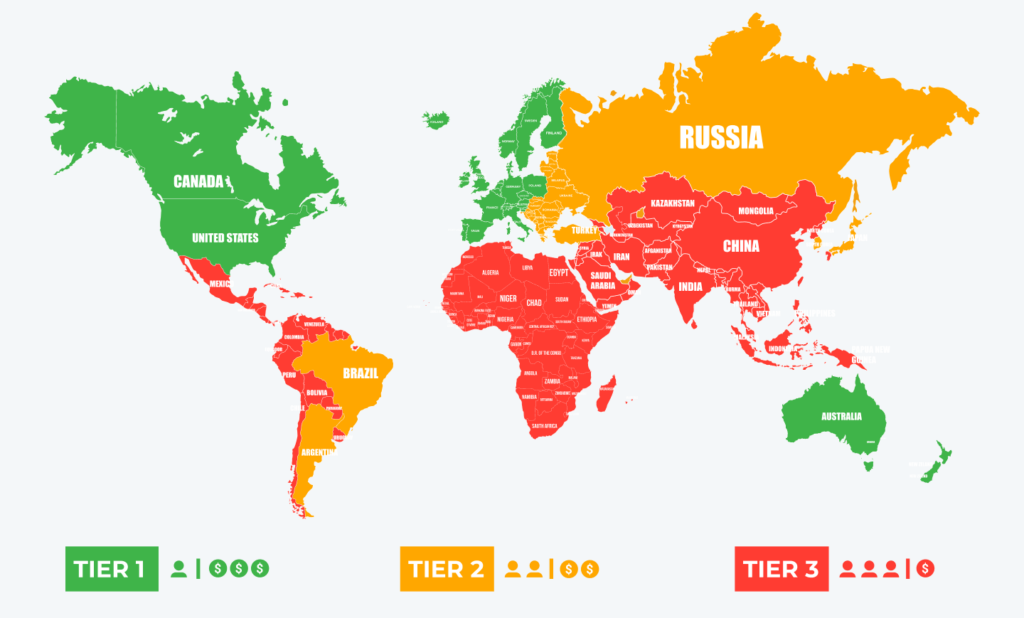
A Tier 1 GEO, a Tier 2 GEO, and a lower-cost GEO may all behave differently. If they are mixed together, you may not see which country is profitable and which one is damaging the economics.
A safer GEO scaling process:
GEO expansion is not simply “more countries.”
It is a set of new mini-campaigns, each with its own economics.
Creative scaling affiliate marketing is about preventing fatigue while expanding volume.
The more you spend, the faster users see the same creative. Frequency rises, CTR falls, CPC increases, and downstream quality can decline.
A single winning creative is not enough for scaling.
You need a creative system.
This includes:
Creative fatigue during scaling is one of the most common reasons performance drops after budget increases.
The solution is not to replace a working creative with random new ads.
The solution is to build controlled variations around a proven hypothesis and test them before the original creative burns out.
A winning creative should become a creative family, not a single asset.
When one source reaches its limit, traffic source expansion affiliate marketing becomes the next step.
But a new source is not a copy of the old one.
Even if you use the same offer and angle, the audience behavior, ad format, moderation rules, traffic quality, and cost structure may be completely different.
A safe process for scaling into a new traffic source:
Diversifying traffic sources also reduces risk.
If all volume depends on one platform, a moderation change, account issue, auction shift, or algorithm update can damage the entire business.
Several working sources create both growth and stability.
How to protect approval rate when scaling is one of the most important questions affiliates should ask before increasing volume.
Approval rate often drops when new traffic is less targeted, lower intent, or less compliant with offer requirements.
To protect approval rate:
An approval rate drop after scaling is a clear warning signal.
It usually means that the additional volume is not as valuable as the original traffic.
Do not wait until payout is cut or traffic is placed under review. Investigate as soon as approval rate starts moving below the normal range.
Paid rate during affiliate scaling shows whether approved users are actually becoming paying users.
A campaign can maintain lead volume and even approval rate while paid rate declines. That often means the new users are less motivated, less prepared to pay, or less aligned with the offer.
Paid rate can decline because of:
Do not judge scaling only by number of leads.
If paid rate falls, the campaign may be growing in volume but shrinking in quality.
Track paid rate by:
The goal is not to generate more users.
The goal is to generate more users who pay.
Refunds and chargebacks when scaling are especially dangerous because they appear with delay.
After increasing volume, the campaign may look strong for several days. Then refunds, chargebacks, and payout deductions start appearing, and the real net profit becomes much lower.
A rising refund rate after scaling often means the campaign is reaching lower-intent users. They may pay impulsively, misunderstand the offer, or cancel quickly.
A rising chargeback rate can damage the relationship with the affiliate program and may lead to stricter validation or payout cuts.
Affiliate retention after scaling is another critical signal.
If new cohorts retain worse than old cohorts, scaling is reducing user quality. This is especially important for subscription, RevShare, and hybrid offers where long-term value matters more than the first payment.
During scaling, monitor:
Scaling should be measured by mature net revenue, not only by early conversion volume.

Affiliate net profit during scaling can behave differently from gross revenue.
You may increase budget and generate more conversions, but still earn less profit if traffic cost rises or quality declines.
For example:
This is not scaling.
This is buying more unprofitable traffic.
To protect affiliate profit while scaling, track:
The key metric is not “more spend.”
The key metric is “more confirmed profit.”
When to scale an affiliate campaign?
Scale when the current level is stable.
Good signs include:
Do not scale because one day was profitable.
Do not scale because a single creative had high CTR.
Do not scale because the dashboard shows gross revenue before deductions.
Scale because the funnel has proven economics and enough control to handle more volume.
Sometimes the smartest scaling decision is to stop.
Stop or pause scaling when:
Stopping growth is not failure.
It is part of controlled scaling.
You pause, diagnose, remove weak segments, refresh creatives, confirm caps, or adjust GEOs. Then you continue only when the economics are stable again.
How to increase affiliate offer caps is not only a negotiation question.
It is a quality question.
Affiliate programs are more likely to raise caps for partners who prove that their traffic converts, pays, retains, and stays within offer rules.
Before asking for higher caps, prepare:
Do not surprise the affiliate program with a sudden volume spike.
Warn the manager before increasing traffic significantly.
This helps avoid unnecessary traffic validation, payout holds, or cap conflicts.
A professional message might look like:
“We have stable performance on GEO X with source Y. Approval rate and paid rate have remained stable over the last two weeks, refunds are within normal range, and we plan to increase volume gradually by 20–30%. Can we confirm available cap and quality requirements before scaling?”
This kind of communication makes growth easier for both sides.
Use this affiliate campaign scaling checklist before increasing budget:
Scaling without a checklist often turns profitable tests into expensive confusion.
Scaling with a checklist protects the parts of the funnel that actually make money.
A practical affiliate scaling strategy can look like this:
This is what safe affiliate budget increase looks like in practice.
More traffic does not automatically mean more profit.
In affiliate marketing, scaling only works when volume grows without destroying the quality that made the funnel profitable in the first place.
The affiliates who scale successfully are not the ones who increase budgets the fastest. They are the ones who know their profitable segments, monitor approval and paid rate, control refunds and chargebacks, refresh creatives before fatigue, confirm caps, and stop when the numbers show risk.
A strong scaling process is disciplined:
prove the funnel → identify profitable segments → increase gradually → monitor downstream quality → protect net profit.
That is how affiliate traffic scaling becomes controlled growth instead of a faster way to lose budget.
Scale an affiliate funnel by identifying profitable segments, increasing budget gradually, monitoring approval rate and paid rate, refreshing creatives, expanding GEOs separately, and protecting net profit after deductions.
Traffic quality can drop because the traffic source expands beyond the best audience, CPC rises, weaker placements enter the campaign, creatives fatigue faster, and new users may have lower intent.
Scale when the campaign has stable approval rate, paid rate, EPC, net profit, acceptable refunds and chargebacks, confirmed caps, working tracking, and enough data across several periods.
Protect approval rate by scaling proven SubIDs first, removing weak placements, keeping creatives aligned with the offer, confirming allowed traffic, and monitoring quality by GEO, source, and creative.
Safe affiliate budget scaling means increasing spend step by step, often by 20–30%, then checking whether traffic quality and net profit remain stable before increasing again.
Stop scaling when approval rate, paid rate, EPC, retention, or net profit decline, or when refunds, chargebacks, traffic validation risk, CPC, or payout deductions increase beyond acceptable levels.
Registration takes 2 minutes. No experience needed — we'll teach you everything.
Just fill out the form
Registration takes 2 minutes. No experience needed — we'll teach you everything.