To access the HUNT ME referral program dashboard, enter the email and password you used during registration.
Fill out the form — it takes 2 minutes. A manager will contact you on Telegram, provide free training, and help you get your first result.

Most affiliate losses do not happen because an offer is inherently bad. They happen because campaigns are launched without a clear testing process.
An affiliate sees a few early leads, makes a decision too fast, changes several elements at once, or scales before the real economics of the campaign are clear. As a result, potentially profitable setups get shut down too early, while weak campaigns keep consuming budget without a defined stopping point.
This is especially relevant when testing adult offers. Looking only at clicks or lead volume is not enough. You also need to consider approval rate, paid rate, refunds, chargebacks, retention, rebills, and other delayed events that may appear days after the first conversion.
In this guide, we will break down how to build an adult offer testing system, set an affiliate testing budget, write useful testing hypotheses, choose the right affiliate testing metrics, and define clear stop criteria before you spend too much.
Many affiliates treat testing as simply sending traffic to a new offer and waiting for the numbers to appear.
Earn with HUNT ME — weekly payouts
A proper affiliate offer testing system is more structured. Before launch, you should already know:
The goal is not just to collect leads. The goal is to answer a specific business question.
For example, should you scale the offer, improve the funnel, test a different traffic source, or stop the campaign entirely?
This approach saves money because it helps isolate the real problem. It may be the offer itself, the GEO, the creative, the landing page, the traffic source, payment conversion, or the quality of the audience.
Without a system, affiliates often change everything at once and never learn what actually improved or damaged performance.
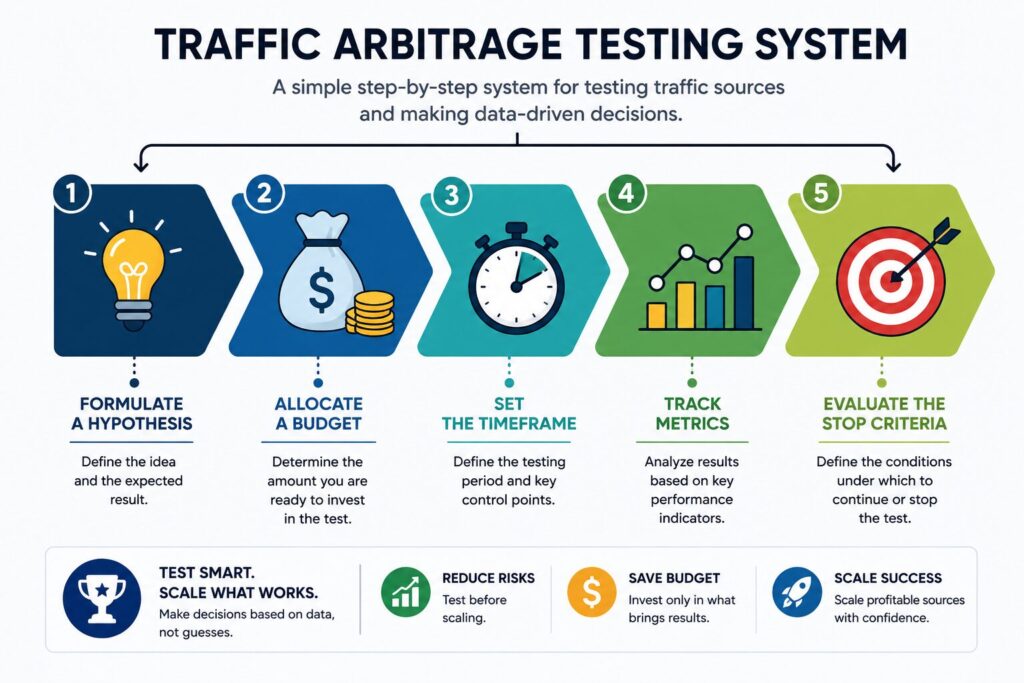
One of the most common mistakes in affiliate marketing is launching traffic with no clear hypothesis.
“Let’s see whether this offer works” is not a testing hypothesis. It is too broad and gives you no reliable way to interpret the result.
A useful hypothesis should be specific and measurable.
Earn with HUNT ME — weekly payouts
For example:
The clearer the question, the easier it is to evaluate the answer.
Affiliate testing hypotheses can focus on:
A good test checks one important variable at a time. If you change the creative, GEO, traffic source, landing page, and targeting all at once, you will not know which decision caused the result.
A common question is: how much money do you need to test an offer?
There is no universal number. An affiliate testing budget depends on several factors:
The goal of an offer testing budget is not to spend “whatever you can afford to lose.” It is to collect enough data to make a reasonable decision.
A budget that is too small can create false conclusions. A few clicks or several leads may look promising or disappointing purely by chance.
At the same time, a test with no spending limit can become an uncontrolled loss.
A practical testing budget should do two things:
For subscription or RevShare offers, the initial budget should also account for delayed revenue. The first-day numbers may not reflect the full value of the traffic.
There is no perfect testing period that works for every campaign.
Fast traffic sources may produce early signals within hours or on the first day. However, early signals are not always final results.
Subscription offers often require more patience because key events may appear later:
This is why adult offer testing should account for event delays. A campaign that looks weak on day one may become profitable once more payment data appears.
The required timeline depends on the funnel.
For example, a creative test in short-form video traffic may reveal early CTR and click-quality signals quickly. But determining whether the same traffic produces reliable payments, low refunds, and stable retention requires more time.
Do not stop a campaign only because the first day is disappointing. Instead, compare the result with the timeline and success criteria you defined before launch.
Affiliate testing metrics should cover the full funnel, not just the first click or first lead.
Key metrics include:
Each metric answers a different question.
Clicks and CTR show whether the creative can attract attention.
Lead conversion shows whether the landing page, prelander, and traffic message are aligned.
Approval rate and paid rate help evaluate traffic quality.
EPC and ROI show whether the economics work.
Refunds, chargebacks, retention, and rebills show whether the campaign remains profitable after the first conversion.
This is particularly important for adult offers with subscriptions or recurring billing. A campaign may generate cheap leads but still lose money if users do not pay, cancel quickly, or generate a high level of refunds.
Early data matters, but it should be treated as a directional signal rather than a final decision.
A high CTR does not equal revenue.
A lead does not equal a paid user.
A strong approval rate does not automatically mean high lifetime value.
A low cost per lead does not guarantee profitability.
Refunds can change the campaign economics days after the first conversion.
This is why affiliate testing needs depth. When evaluating a campaign, ask where the funnel is actually breaking.
For example:
The earlier you identify the broken stage, the less money you waste on random changes.
One creative rarely shows the full potential of an offer.
Creative testing for adult offers should include multiple angles, formats, and audience messages. The goal is not only to find the highest CTR but also to find creatives that attract users who are more likely to complete the funnel and stay valuable after the first conversion.
You can test different approaches such as:
The important rule is to change one major variable at a time.
For example, test several creative angles while keeping the same GEO, landing page, and traffic source. Once you identify a stronger angle, you can test new variations inside that angle.
This creates a clear learning process instead of a collection of random campaign results.
It is common to hear affiliates say that a traffic source does not work for a specific offer.
In reality, the issue may be somewhere else.
Possible reasons include:
Traffic source testing should be separated from offer testing whenever possible.
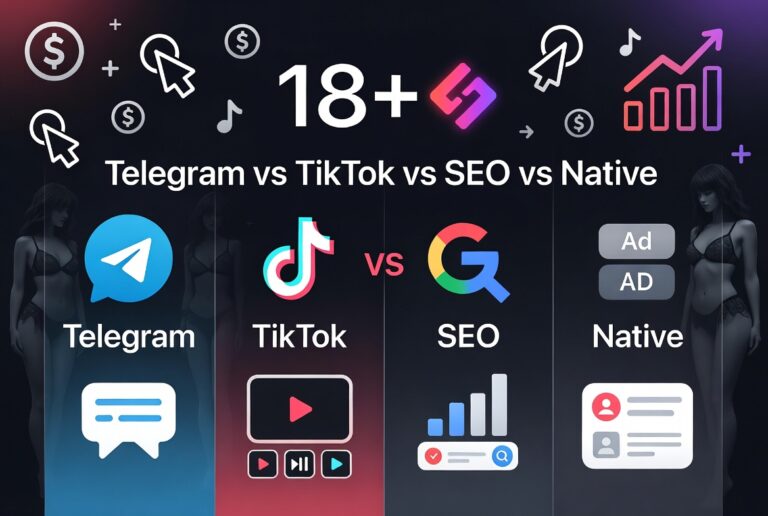
The same adult offer may perform differently in TikTok, Telegram, SEO, native ads, push traffic, or ad networks because user intent and behavior are different in every channel.
A source that produces weak immediate conversions may still work with a better prelander, a different creative angle, or a more suitable audience segment.
GEO testing in affiliate marketing should be done separately for each country or market group.
Different GEOs can vary significantly in:
One of the biggest mistakes is combining multiple countries into a single campaign and evaluating only the average result.
For example, one GEO may be profitable, another may generate cheap leads but poor paid rate, and a third may have strong payments but high refund levels. When all traffic is mixed together, you cannot see which market is actually driving the outcome.
Separate GEO testing makes optimization more precise and helps you protect profitable segments from being hidden by weak ones.
Landing page testing affiliate campaigns should not be evaluated by conversion rate alone.
A direct link may produce more initial leads, but a prelander can improve traffic quality by giving users more context before they reach the offer.
A prelander may help:
This means a prelander can sometimes reduce top-of-funnel conversion while improving the final economics of the campaign.
The correct way to evaluate a landing page or prelander is to look at the full funnel:
click → prelander → lead → approved lead → paid user → retention → refund or rebill outcome.
The best page is not necessarily the one that generates the most leads. It is the one that contributes to the strongest net result.
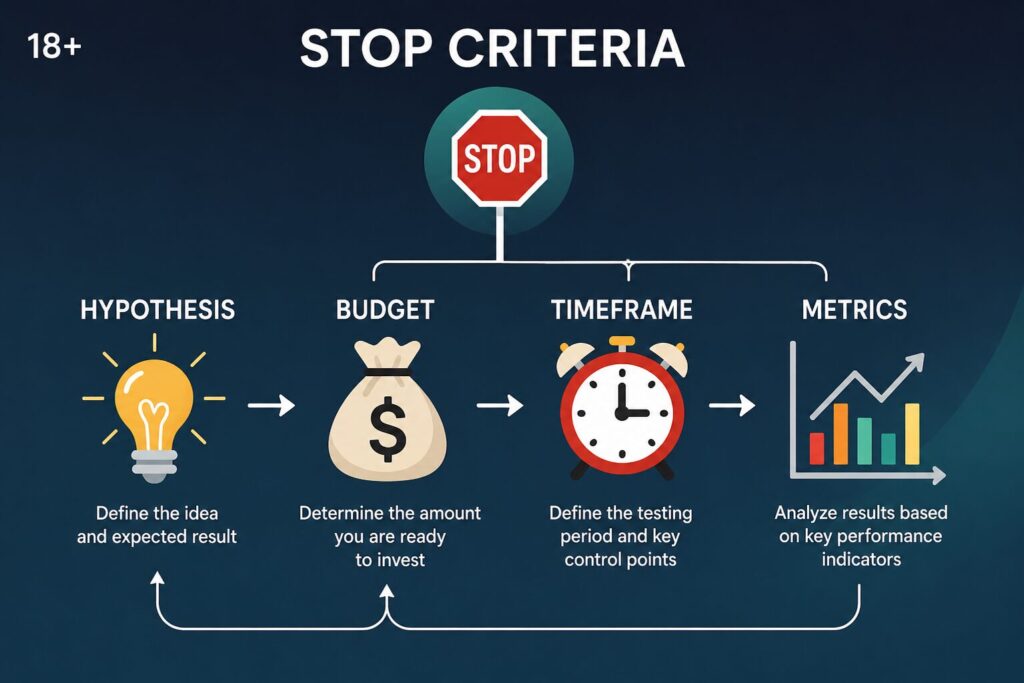
Affiliate stop criteria should be defined before the campaign begins.
Without clear stop rules, decisions become emotional. Some affiliates kill potentially good campaigns too early, while others continue spending long after the data shows that the setup is unlikely to recover.
Common stop criteria include:
A stop criterion should not be based on one disappointing metric alone. It should reflect the whole campaign logic.
For example, a weak CTR might justify changing the creative, while strong clicks but no leads may point to a landing-page issue. Stopping the entire offer without checking the funnel can lead to poor decisions.
Not every weak result means the offer has failed.
Sometimes the test shows a clear improvement opportunity.
For example:
The key is to identify the weakest stage and change only that part.
Do not restart the entire campaign from scratch if the data already tells you where the problem is.
When to scale an affiliate campaign depends on whether the economics are confirmed, not whether you saw a few good leads.
Scaling should usually happen only when you have:
Scaling too early can make a weak problem bigger. It can also reduce traffic quality, exhaust creatives, or trigger additional quality reviews.
A gradual increase gives you time to monitor whether paid rate, EPC, ROI, and retention remain stable as volume grows.
An affiliate testing journal becomes more valuable over time.
It helps you understand which offers, GEOs, creative angles, and traffic sources were profitable — and which decisions repeatedly led to losses.
For every test, record:
After several weeks or months, this journal becomes your internal database.
It helps you avoid repeating failed tests, identify patterns faster, compare sources fairly, and make better scaling decisions based on your own data rather than someone else’s case study.
The most common mistakes include:
Most wasted budget comes from chaotic decision-making, not from bad offers.
Offer testing is not guesswork. Every test should answer a specific question, use a controlled budget, run for an appropriate period, and have clear stop criteria.
The affiliates who succeed with adult offer testing are not necessarily the ones who run the most campaigns.
They are the ones who test systematically.
A structured affiliate offer testing system helps you protect your budget, understand campaign performance, identify profitable segments faster, and scale only when the economics are real.
Set a clear hypothesis. Define your budget. Track the full funnel. Wait for delayed events when needed. Record your results. Then make decisions based on evidence, not emotion.
That is how testing becomes a repeatable process instead of an expensive guessing game.
There is no universal amount. Your offer testing budget should be large enough to collect useful data based on traffic costs, expected conversion rates, and the payout model. Avoid making decisions based on only a few clicks or leads.
Stop when your predefined affiliate stop criteria are met. This may include an unacceptable cost per lead, weak approval rate, no paid events after a sufficient sample, high refunds, or a traffic-source compliance issue.
Scale only after paid rate, approval quality, refund level, and ROI are stable. You should also know which GEOs, creatives, placements, or audience segments are generating profitable traffic.
Important metrics include approval rate, paid rate, EPC, ROI, refunds, chargebacks, retention, rebills, and net revenue. The exact priority depends on the offer model and traffic source.
A prelander can prepare users before they reach the offer. It may reduce low-intent clicks, improve paid rate, increase trust, and lower refund risk. Evaluate it by the final economics, not only top-of-funnel conversion.
A testing journal helps you track offers, creatives, GEOs, costs, payouts, and performance changes. It prevents repeated mistakes and becomes a valuable source of your own campaign data over time.
Registration takes 2 minutes. No experience needed — we'll teach you everything.
Just fill out the form
Registration takes 2 minutes. No experience needed — we'll teach you everything.