To access the HUNTME referral program dashboard, enter the email and password you used during registration.
Fill out the form — it takes 2 minutes. A manager will contact you on Telegram, provide free training, and help you get your first result.
Low CPC looks attractive in almost every paid traffic campaign.
If one source sells clicks for $0.08 and another sells clicks for $0.60, the first one feels like the obvious choice. For the same budget, you can buy more visitors, collect data faster, and potentially generate more leads.
But affiliates do not buy traffic for the sake of clicks.
They buy traffic to reach users who move through the funnel: they register, pass approval, make payments, avoid refunds, and, if the offer model allows it, stay long enough to generate recurring revenue.
That is why a cheap click does not always mean a cheap customer.
Earn with HUNT ME — weekly payouts
Sometimes expensive traffic brings users with much stronger intent, higher purchasing power, better approval rate, stronger paid rate, lower refund risk, and better long-term value. In that case, every dollar spent may produce more real profit.
At the same time, thousands of cheap clicks can create impressive volume in the dashboard while quietly destroying the economics of the campaign.
The real task is not to find the lowest cost per click.
The task is to understand how much it costs to bring a user to revenue — and how much that user brings after approvals, refunds, chargebacks, deductions, and all traffic costs.
Cost per click is one of the first numbers affiliates see after launching a campaign.
It is simple. It is visible almost immediately. It feels objective.
Paid rate, refund rate, retention, and LTV take more time to understand. CPC is available right away.
That is why affiliates often make several mistakes:
Earn with HUNT ME — weekly payouts
This is especially common with traffic sources where a small budget can quickly produce large volume.
A campaign gets thousands of clicks and hundreds of registrations, so it feels like the next step should be scaling.
Then, several days or weeks later, the real picture appears: approval rate is weak, users do not pay, refunds begin to appear, and final net profit is negative.
Cheap traffic affiliate marketing is not bad by itself.
The mistake is assuming that traffic is profitable only because the first step of the funnel is cheap.

CPC only shows the cost of entering the funnel.
To evaluate audience quality in affiliate marketing, you need to look much deeper.
Important metrics include:
The combination of these metrics determines which traffic source is more profitable.
A source can have expensive clicks but also strong approval rate, high paid rate, low refunds, and better retention. In that case, a smaller number of users can generate more real money.
The opposite is also common. A cheap traffic source may look good up to the lead stage and then collapse deeper in the funnel.
Affiliate traffic quality is not proven by click price.
It is proven by what happens after the click.
The main logic is simple: the cost of a click matters only when compared with the value that click produces.
Imagine two traffic sources.
Source A sells clicks for $0.05. With a $500 budget, the affiliate receives 10,000 visits. At first glance, that looks excellent. But the audience is cold, paid rate is weak, and after refunds and deductions, the campaign generates only $420.
The traffic was cheap, but the campaign lost money.
Source B sells clicks for $0.50. The same $500 budget brings only 1,000 visits. But the users match the offer better, pass approval more often, and complete payments more consistently. After all adjustments, the campaign generates $800.
In the second case, each click was ten times more expensive, but the campaign produced profit.
That is why affiliates should compare CPC with EPC.
If real EPC, after traffic quality and adjustments, is consistently higher than CPC, the source can work. If EPC is lower than CPC, low click cost will not save the campaign.
The key is to calculate traffic profitability through the full funnel, not just through the first visible metric.
Low price does not appear in a vacuum.
Sometimes it comes from a real opportunity: an underrated GEO, a less competitive source, a strong creative angle, or a segment that competitors have not found yet.
But cheap inventory can also contain low-intent users, weak placements, poor-quality traffic, or audiences with limited purchasing power.
Problems usually appear deeper in the funnel:
In this situation, the click was cheap, but the user acquisition cost for a paying customer becomes extremely high.
For example, Source A may generate leads for $1, but only one out of twenty users pays. Source B may generate leads for $5, but one out of three users pays.
If you look only at lead cost, Source A looks better.
If you look at real payment conversion, Source B may be much stronger.
This is why downstream metrics show the real cost of traffic.
Expensive traffic is not automatically good.
A source can be expensive simply because competition is high, while still being a poor fit for your offer.
But in many cases, higher traffic cost reflects competition for a more valuable audience.
Expensive traffic may perform better because it has:
User intent is one of the most important factors.
There is a major difference between a user who accidentally clicks a bright banner and a user who is actively looking for a solution and consciously clicks an offer.
Both are counted as one click.
Their economic value can be completely different.
That is why high CPC is not always bad. It becomes a problem only when the higher cost is not supported by stronger monetization.
A lead is an intermediate event.
It shows that the user completed a certain action, but it does not necessarily mean that the user generated money.
This becomes clear when comparing traffic sources.
One source may generate 300 registrations for the same budget, while another generates only 120. If you look only at lead conversion rate, the first source looks better.
But then 12 users from the first source pay, while 30 users from the second source pay.
The conclusion changes completely.
Paid rate affiliate marketing analysis shows whether the traffic source brings users who are willing to move beyond curiosity and spend money.
This is especially important in subscription and adult offers. A user may register easily out of curiosity, but payment is a much stronger signal of quality.
Then recurring payments and retention become even more important.
Scaling only by lead cost often pushes affiliates toward traffic that creates cheap actions but weak monetization.

Approval rate works in a similar way.
Imagine two sources.
One generates leads for $2. The other generates leads for $4.
The first source looks twice as cheap.
But the affiliate program approves only 30% of leads from the first source and 80% from the second source.
Now the real cost of an approved lead looks very different.
Low approval rate can be caused by:
That is why affiliate lead quality cannot be judged only by lead volume.
If cheap traffic constantly brings users the advertiser does not consider valuable, low CPC only helps generate low-quality volume faster.
Some traffic sources look excellent in the first few days.
There are clicks, leads, approved users, and even payments. The affiliate sees revenue and starts increasing the budget.
The problem appears later.
Users may pay impulsively and quickly request refunds. They may misunderstand the offer. In subscription models, they may not be prepared for future billing. In more serious cases, chargebacks appear.
Then part of the original revenue disappears after adjustments.
This is why traffic should not be compared only by early results.
Source A may show $1,000 in revenue after three days and end with $650 after refunds and chargebacks mature. Source B may show only $850 at first but keep almost all of it.
On mature data, the second source may be better.
For offers with recurring payments, this becomes even more important. Sometimes a more expensive user produces much higher LTV because they stay longer and generate repeated payments.
Expensive traffic and LTV should always be evaluated together.
Traffic cost depends heavily on country.
That makes comparing GEOs only by CPC too simplistic.
Tier 1 countries usually cost more. At the same time, users in those markets may have stronger purchasing power and be more used to paying for online services.
But this does not mean Tier 1 is automatically more profitable.
Cheaper GEOs may also work well if payout, conversion rate, payment methods, and user behavior match the offer.
Different countries can vary by:
A $0.20 click in one GEO and a $0.70 click in another GEO are not the same user with a different price tag.
They are different audiences with different downstream economics.
That is why traffic profitability should be calculated separately by GEO, not averaged into one blended number.
Cheap traffic is not a red flag by itself.
Sometimes affiliates find a source, segment, placement, or GEO with excellent economics.
Cheap traffic can be useful for:
Cheap traffic can be highly profitable when:
In that case, low cost is a real competitive advantage.
The problem is not cheap traffic.
The problem is failing to check what happens after the click.
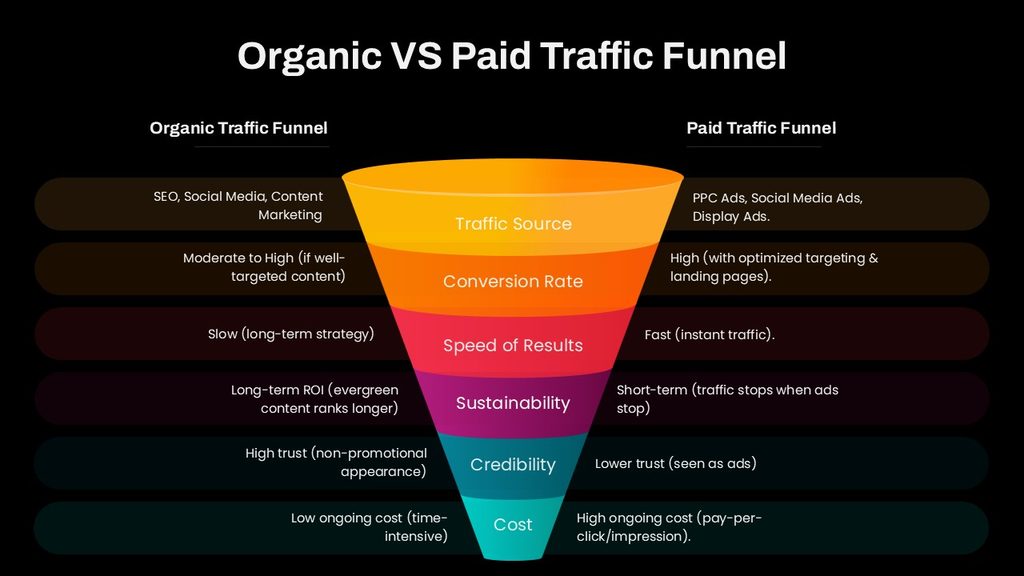
The opposite mistake is assuming that expensive traffic is automatically high quality.
It is not.
High CPC does not save a campaign if the offer does not match the source, the creative attracts the wrong expectations, or the payment flow destroys conversion.
Expensive traffic becomes dangerous when:
On a cheap source, a mistake may cost a few hundred dollars.
On an expensive source, the same amount of data can cost much more.
So the point is not that expensive traffic is better than cheap traffic.
The correct point is this: high CPC is acceptable only when the stronger economics justify the higher cost.
To understand which traffic source is more profitable, both sources must be tested under comparable conditions.
Ideally, compare them using:
You should compare:
A comparison like “this source has $0.12 clicks and that source has $0.45 clicks” says almost nothing about profitability.
The question is not which source is cheaper.
The question is which source produces more confirmed profit after all costs and corrections.
A high entry cost requires careful validation before scaling.
Strong signals include:
It is especially important to watch how audience composition changes after increasing the budget.
At low volume, the source may give you the best placements and the most relevant users. After scaling, reach expands and average quality can decline.
That is why scaling profitable traffic sources should happen gradually.
After each meaningful budget increase, review paid rate, EPC, refund rate, and net profit again.
Low CPC is not a reason to keep losing money.
A cheap source needs serious cleaning or pausing when it consistently shows:
Before stopping the whole source, review placements, SubIDs, GEOs, devices, and creatives.
Sometimes the source itself is good, but several weak segments destroy the average.
However, if paid rate, EPC, and net profit do not recover after cleaning, keeping that traffic only because clicks are cheap makes no sense.
It simply spends the budget faster.
The more expensive the source, the more disciplined the test must be.
Before launching, define:
Also check:
Do not scale based on the first cheap leads or one successful payment.
For expensive traffic, it is especially important to wait for mature data:
If part of the revenue is still in hold, include that in cash-flow planning.
This makes high CPC a normal part of unit economics instead of an emotional barrier.
Instead of asking whether traffic is cheap or expensive, use the same evaluation process for every source:
This removes the false choice between cheap and expensive traffic.
Affiliates do not need the cheapest source.
They need the most profitable source at the volume they can control.
Most mistakes come from making conclusions too early.
Affiliates often:
In all these cases, cost per click is treated as a performance metric, although it is only the cost of the first contact.
After the click, the user may generate $0, $10, or $500.
That is why CPC without downstream metrics says very little about the real value of the audience.
A cheap click can become very expensive if the user does not pass approval, does not pay, or quickly requests a refund.
An expensive click can be highly profitable if the audience has purchasing power, fits the offer, passes validation, and stays long enough to generate value.
That is why affiliates should evaluate the full chain:
CPC → Lead → Approval → Paid → Refund → Retention → LTV → Net profit.
Sometimes the winner will be the cheapest source. If low cost comes with strong paid rate and clean traffic quality, that is an excellent situation.
But if a more expensive source produces fewer clicks and more confirmed profit, there is no reason to fear the higher CPC.
In affiliate marketing, you should not scale clicks.
You should not even scale leads.
You should scale positive economics.
That is the real difference between buying traffic and building a profitable affiliate campaign.
Expensive traffic can be more profitable when it brings users with higher intent, stronger purchasing power, better approval rate, higher paid rate, lower refund risk, and stronger long-term value.
No. Cheap traffic can be profitable if approval rate, paid rate, EPC, retention, and net profit remain strong. The problem starts when affiliates judge traffic only by low CPC.
CPC shows how much a click costs. EPC shows how much revenue a click generates on average. A traffic source becomes interesting when mature EPC remains higher than CPC after refunds, chargebacks, and deductions.
Cheap clicks can become expensive if they produce low-quality leads, weak approval, poor paid rate, high refunds, chargebacks, or low retention.
High-quality affiliate traffic usually shows stable approval rate, strong paid rate, low refund and chargeback rates, good retention, clean SubID performance, and positive net profit.
A traffic source should be scaled when EPC remains above CPC, approval rate and paid rate stay stable, refunds are controlled, net profit grows with budget, and weak segments can be separated and removed.
Registration takes 2 minutes. No experience needed — we'll teach you everything.
Just fill out the form
Registration takes 2 minutes. No experience needed — we'll teach you everything.