To access the HUNT ME referral program dashboard, enter the email and password you used during registration.
Fill out the form — it takes 2 minutes. A manager will contact you on Telegram, provide free training, and help you get your first result.
One of the easiest mistakes in affiliate marketing is choosing a GEO because the click price looks cheap.
An affiliate opens a traffic source, sees that clicks in one country cost five times less than in Germany, the UK, Australia, or Canada, and assumes the opportunity is obvious: more clicks for the same budget should mean more leads.
A week later, the campaign tells a different story.
There are leads, but very little money. Approval rate is weak. Paid rate is low. Some payments fail. Refunds start appearing later. The campaign looked cheap at the click level, but expensive at the profit level.
That is the key lesson in adult traffic GEO selection: the cheapest click is not always the cheapest customer.
Earn with HUNT ME — weekly payouts
Between a click and real revenue, there are many steps:
Every country behaves differently across these steps.
That is why a strong adult affiliate GEO strategy is not based only on CPC or CPM. It is based on the full economic chain from traffic cost to confirmed net profit.
In this guide, we will break down how to choose GEO for adult traffic, how to evaluate GEO before launch, and how to compare GEO profitability using click cost, purchasing power, payment methods, approval rate, paid rate, refunds, chargebacks, and payback period.
In affiliate marketing, GEO means more than a country name in your campaign settings.
A GEO represents a combination of user behavior, traffic price, purchasing power, payment habits, local language, device usage, platform restrictions, billing success, refund patterns, and risk level.
Two countries can look similar on paper and perform completely differently in a real campaign.
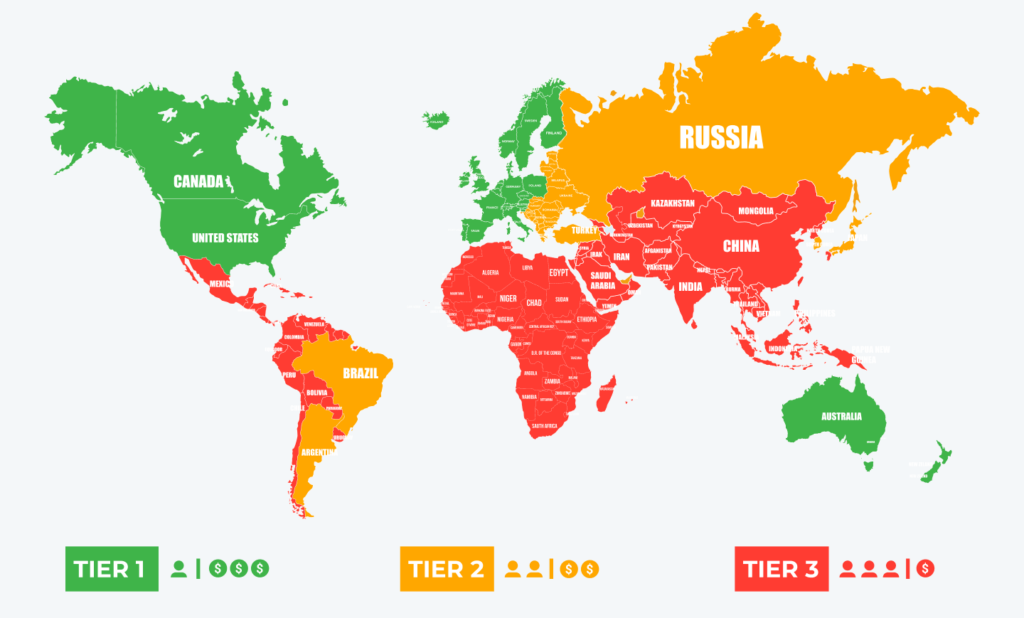
That is why the common Tier 1, Tier 2, Tier 3 affiliate marketing classification is useful, but limited.
Earn with HUNT ME — weekly payouts
Tier 1 usually includes high-purchasing-power markets such as the United States, Canada, the United Kingdom, Germany, Australia, and other developed markets.
Tier 2 often includes parts of Eastern Europe, Latin America, Asia, and mid-income markets.
Tier 3 usually refers to cheaper traffic markets with lower average purchasing power and weaker monetization potential.
This classification is helpful for orientation, but it should not be treated as a final decision-making system.
Not every Tier 1 GEO is automatically profitable. Not every Tier 3 GEO is useless. Some lower-cost countries can produce strong results if payment methods, localization, and offer fit are good. Some expensive countries can become unprofitable if competition is too high, refunds are elevated, or the offer does not match the audience.
Experienced affiliates do not choose countries by label.
They evaluate each GEO based on the offer, traffic source, payment model, funnel, and final economics.
Click cost by country affiliate marketing reports can be misleading when used alone.
CPC and CPM show how expensive it is to enter the auction. They do not show whether users will register, get approved, pay, stay active, or avoid refunds.
A cheap click can become an expensive paid user.
For example:
At first glance, Country A looks five times cheaper.
But if one paid user comes from every 100 clicks in Country A, the cost per paid user is $10.
If eight paid users come from every 100 clicks in Country B, the cost per paid user is about $6.25.
Country B had more expensive clicks, but better payment conversion.
That is why adult offer payment conversion by country matters more than the click price alone.
When evaluating GEOs, look at the full funnel:
The right question is not “Where is traffic cheapest?”
The right question is “Where does the full funnel produce profitable users?”
Purchasing power by GEO is one of the most important variables in adult affiliate campaigns.
Paid rate by country affiliate marketing analysis shows how many users move from interest to actual payment. This is where many cheap GEOs fail.
Purchasing power depends on several factors.
The first is disposable income. In markets where users have limited money for online entertainment, fewer people will pay, even if they click and register.
The second is payment behavior. Some users are comfortable paying online. Others hesitate to use cards, subscriptions, or international payment flows.
The third is access to payment tools. In some countries, a large share of users may not have cards that work for international online payments. In others, local wallets or mobile payments may dominate.
The fourth is trust. Users may abandon payment if the page looks foreign, the currency is unfamiliar, the language is weak, or the billing step feels risky.
Purchasing power does not always equal national wealth.
Some mid-income markets have strong digital payment habits and good microtransaction behavior. Some higher-income markets may be cautious with certain types of subscriptions or more likely to request refunds.
That is why adult affiliate GEO strategy should be based on actual funnel data, not only economic assumptions.
Even when a user wants to pay, the payment may fail.
This is one of the most underestimated reasons why a GEO does not perform.
Payment methods by GEO can vary dramatically. In some countries, Visa and Mastercard dominate. In others, local cards, wallets, mobile payments, bank transfers, or alternative payment methods are more important.
A common problem looks like this:
The affiliate sends traffic to a GEO where the audience prefers local wallets or mobile payments. The offer supports only standard card billing. Users reach the payment step, but the preferred option is missing. They leave.
From the affiliate’s side, the campaign may look like it has weak paid rate.
In reality, the payment flow does not fit the GEO.
International payment declines are another issue. Some banks reject transactions more often for specific merchant categories, foreign processors, or subscription payments. Anti-fraud systems may also block more payments from certain regions.
Before launching a GEO, ask the affiliate program:
Payment conversion can make or break GEO profitability.
Approval rate by GEO affiliate marketing data shows how much submitted traffic is accepted as valid.
Some GEOs naturally produce cleaner traffic. Users register with real intent, complete required steps, and match advertiser expectations. Other GEOs may have more bot traffic, duplicate users, low-intent registrations, accidental clicks, proxy usage, or poor-quality leads.
But approval rate is not only about the country.
It is the result of a combination:
A country may perform well with native traffic but poorly with low-quality pop traffic. Another GEO may approve well with a clear prelander but fail when the creative creates unrealistic expectations.
Affiliate traffic quality by GEO should always be analyzed together with source and creative.
If approval rate is low, do not immediately blame the country. Break the data down by placement, creative, device, SubID, source, and landing-page path.
A weak segment may be damaging an otherwise workable GEO.
Refunds and chargebacks by GEO are often ignored during early testing.
That is dangerous because they can appear after the campaign already looks profitable.
A GEO can produce strong paid volume and still become weak after delayed refunds and chargebacks are applied.
Refunds happen when users request their money back through the normal refund process.
Chargebacks happen when users dispute the payment through a bank or payment provider.
Both can reduce final affiliate revenue.
Refund and chargeback behavior varies by country. Some markets have a stronger consumer dispute culture. Some users are more likely to cancel subscriptions quickly. Some GEOs may have more payment confusion, especially when the price, currency, or billing terms are not clear.
High refund or chargeback rates can destroy net profit even when CPC, approval rate, and paid rate look acceptable.
That is why adult traffic risks by country should include:
A GEO is not truly profitable until you understand what remains after refunds and chargebacks.
The best GEOs for CPA offers are not always the best GEOs for RevShare offers.
The payout model changes what kind of country makes sense.
CPA offers pay a fixed amount for a defined action. This model is useful when you want faster feedback, clearer short-term economics, and less dependence on long-term user behavior.
CPA can work well in GEOs where traffic volume is good and approval rate is stable, even if long-term retention is uncertain.
RevShare offers depend on user lifetime value. You earn a percentage of user revenue over time. This model works better in GEOs with stronger purchasing power, reliable payment methods, lower refund rates, and better retention.
The best GEOs for RevShare offers are usually those where users not only pay once but continue paying over time.
Hybrid models combine an upfront payout with future revenue share. They can be useful in mid-range GEOs where affiliates want faster payback while still keeping long-term upside.
The main rule is simple:
Do not evaluate a RevShare GEO with the same time horizon as CPA. RevShare requires cohort analysis, rebill tracking, refund monitoring, and a clear GEO payback period.
Landing page localization by GEO is not just a design detail.
It directly affects trust, conversion, payment behavior, and refund risk.
Good localization includes:
Poor localization can ruin an otherwise strong GEO.
Users are less likely to register or pay when the landing page feels translated mechanically, shows an unfamiliar currency, or looks clearly built for another market.
Currency and language localization affiliate campaigns often see better results because users understand the offer faster and trust the payment step more.
Localization also reduces mismatch. If the ad, prelander, landing page, and offer all speak the same language and set the same expectation, users are less likely to abandon the funnel or request a refund later.
GEO cannot be selected separately from the traffic source.
The same country may perform differently depending on where the traffic comes from.
Push and pop traffic can provide volume and lower click costs, but may require careful filtering because intent can be weaker.
Native ads may bring more informed users, but the click cost is usually higher and the prelander must do more work.
Social traffic can be powerful, but adult-related restrictions, moderation rules, and creative limitations make compliance and funnel design more important.
Search and SEO traffic may have stronger intent, but volume, competition, and time to scale are different.
Messenger or community-based traffic may perform well when trust and warm-up matter, but it is harder to scale quickly.
When choosing a GEO, ask:
A GEO may be excellent economically but useless in a source that cannot deliver enough qualified traffic.
Testing too many countries at once is a common mistake.
If you spread a small budget across ten GEOs, you may not collect enough data in any of them. The result is noise, not insight.
A better approach is structured testing.
Start with a clear hypothesis.
For example:
Choose 2–4 GEOs with a similar logic rather than testing everything randomly.
Keep the test conditions as consistent as possible:
Do not stop a GEO after a few clicks.
Do not scale a GEO after one lucky payment.
Wait for enough data across the funnel, including approval, paid events, refunds, chargebacks, and delayed reporting.
The purpose of a GEO test is not to find the country with the most leads.
The purpose is to find the country with the strongest economics.
How to compare GEO profitability properly?
Do not compare only leads.
Compare net profit by GEO affiliate campaigns.
For each country, track:
A country with fewer leads can be more profitable than a country with large volume if users pay more, stay longer, and refund less.
A GEO with lower ROI but faster payback may also be better for affiliates with limited working capital.
For example, a CPA GEO may return money faster, while a RevShare GEO may produce stronger long-term profit but require more patience and cash flow.
That is why GEO performance analysis affiliate marketing teams should include both profit and timing.
A profitable GEO that takes too long to pay back may still be hard to scale.
GEO payback period affiliate marketing analysis shows how long it takes to recover traffic costs for users acquired in a specific country.
This matters because different GEOs monetize at different speeds.
Some countries may generate quick CPA revenue. Others may require several rebills before becoming profitable. Some GEOs may have a long hold period or delayed payment reporting.
When evaluating payback period, ask:
A GEO with strong long-term LTV may still be risky if the payback period is too long for your budget.
This is why choosing countries is partly a financial decision, not only a marketing decision.
The most common mistakes include:
Each mistake can reduce ROI.
Together, they can turn a promising campaign into a losing one.
After testing a country, there are usually three possible decisions.
Scale the GEO when the economics are stable: positive ROI, acceptable refund and chargeback levels, good approval rate, strong paid rate, manageable payback period, and enough available traffic volume.
Improve the GEO when there is potential but one part of the funnel is weak. For example, traffic quality may be good, but localization is poor. Paid intent may exist, but payment methods do not fit. Approval may be weak because the creative attracts the wrong users.
Stop the GEO when the economics do not work across the funnel. If users do not pay, refunds are too high, payment success is weak, or cost per paid user is too expensive, the budget may be better used elsewhere.
Do not fall in love with a country because the click price is attractive.
A GEO is a business unit. It should earn money or provide a clear path to improvement.
The best countries for adult offers are not always the countries with the lowest traffic cost.
A strong GEO is a country where the full funnel is predictable:
Cheap clicks without purchasing power, payment conversion, and traffic quality are not an opportunity. They are a hidden cost.
When choosing GEOs, think like an investor. Do not choose by entry price alone. Choose by expected return, risk, cash flow, and scalability.
That is how GEO selection stops being a guessing game and becomes a controlled part of affiliate campaign growth.
Choose GEOs by evaluating click cost, purchasing power, payment methods, approval rate, paid rate, refunds, chargebacks, traffic quality, localization, and net profit potential.
No. Tier 1 GEOs often have stronger purchasing power but also higher competition and traffic costs. Some Tier 2 or lower-cost GEOs can perform well if payment methods and offer fit are strong.
A cheap GEO can become unprofitable if users do not pay, approval rate is low, payment methods do not fit, refunds are high, or chargebacks reduce final revenue.
No single metric is enough. Net profit by GEO is usually the most important final metric, but it should be analyzed together with approval rate, paid rate, refund rate, traffic cost, and payback period.
It is usually better to test a small group of 2–4 GEOs with enough budget for meaningful data rather than spreading the budget across too many countries.
RevShare usually works better in GEOs with strong purchasing power, reliable payment methods, good retention, lower refund risk, and a reasonable long-term LTV.
Registration takes 2 minutes. No experience needed — we'll teach you everything.
Just fill out the form
Registration takes 2 minutes. No experience needed — we'll teach you everything.