How Affiliates Can Avoid Losing Candidate Applications With a Weak First Message
11 min read · 10.11.2026 · 3 views

Contents
- Why the First Recruiting Message Matters
- What Candidates Should Understand in the Opening Lines
- Avoid Using an Earnings Promise as the Entire Hook
- A Practical Structure for the First Message
- How to Write Short and Clear Recruiting Messages
- Write Headlines That Match the Actual Role
- How to Write a Recruiting Post for Telegram or Social Media
- How to Write the First Personal Message
- Why “I Have an Opportunity” Leaves Too Much Unclear
- Phrases That Support Candidate Trust
- How to Discuss Earnings in the First Message
- Make the Next Step Specific
- Let the Message Help People Assess Fit
- Find Where the Conversation Loses Momentum
- Analyse the Replies as Well as Their Number
- How to Test Recruiting Messages
- Keep the Tone Human and Follow Up Carefully
- First Recruiting Message Checklist
Even a relevant opportunity can lose a suitable candidate at the first interaction. Before someone reads the full conditions, they see a few lines: a message, headline, post, or opening section of a page. Those lines help them decide whether to continue.
The first message does not need to explain the entire offer. It needs to provide enough context for the person to make a small, informed decision: read more, ask a question, or decline.
Want to start without experience?
Start with stream models: you look for people using ready-made scripts, and production companies handle the interview and training.
This guide explains how to write the first message to a candidate, describe the opportunity without exaggerated promises, and evaluate performance beyond reply rate.
Why the First Recruiting Message Matters
The first contact starts shaping expectations before the candidate sees the details.
A vague message can create uncertainty. An overly promotional message can resemble spam. A large earnings promise without an explanation of the work may attract interest in the figure rather than the role.
Good at finding people? You get paid for it
You find a candidate, production companies and agencies do the rest. Payouts in USDT every Monday.
For example, “Want to earn $5,000?” gives little information about responsibilities, requirements, or how that amount relates to actual conditions.
A more specific message may produce fewer replies while attracting people with a better understanding of the opportunity. Whether that improves results must be checked through applications and subsequent outcomes.
The aim is to make the opportunity understandable from the beginning.

What Candidates Should Understand in the Opening Lines
A reader should be able to identify:
- Who is contacting them and in what capacity.
- The basic role or work format.
- Why the message may be relevant.
- Any essential condition that changes suitability.
- What they are being invited to do next.
- Where they can find further information.
This is a writing checklist, not a measured “five-second rule.” Reading behaviour varies by person, channel, and context.
You can leave detailed procedures and less urgent questions for a later explanation. However, do not withhold a material aspect of the role to obtain a reply.
If the work involves adult content or another sensitive element, the wording should make that clear enough for an informed decision. An attractive generic title should not conceal the nature of the opportunity.
Avoid Using an Earnings Promise as the Entire Hook
Phrases such as “guaranteed high income,” “everyone gets accepted,” and “almost no work required” can create expectations that the actual offer does not support.
Not sure what to write first? The script is ready
After sign-up you get ready-made scripts and a personal manager. No recruiting experience needed.
A prominent maximum figure also needs context. It may describe a conditional result, an exceptional example, or even the affiliate’s reward rather than the candidate’s compensation.
Those are different things.
A stronger opening explains the work and one verified benefit. That benefit might be available training, a confirmed remote arrangement, or a particular schedule option—but only where it applies.
Before drafting a recruiting affiliate message, review the current HUNT ME offers and their requirements. Avoid transferring a condition from one direction to another.
A Practical Structure for the First Message
A useful candidate outreach message can follow this sequence:
Identity and context → role → verified benefit or relevant detail → essential condition → next step
For example, when replying to someone who has asked about a role:
“Hi [name], I’m [name], a recruiting partner following up on your question about [role]. The work involves [accurate description], and the confirmed requirements include [key condition]. Would you like the role details and application process?”
The context must be true. Do not claim that someone asked about an opportunity, that you reviewed their profile, or that a mutual contact recommended them unless that actually happened.
If no benefit has been verified, leave it out. A clear description is more useful than an invented advantage.
How to Write Short and Clear Recruiting Messages
Short does not mean empty.
“Remote work. Interested?” is brief, but it leaves the reader to discover who is writing, what the work involves, and whether it is relevant.
The opposite problem is an opening message containing every requirement, payment detail, training condition, and interview instruction. A new reader may not yet want that much information.
Keep the first message focused on one opportunity and one appropriate next step.
A useful editing question is:
“Can the reader decide whether they want more information without first having to ask what the opportunity is?”
When additional explanation is needed, link to a relevant page or offer to provide the details. For audiences following a series of posts, connected content can do some of that work. Our guide to Telegram content funnels and building trust without pushy selling explains how to organise those steps.
Write Headlines That Match the Actual Role
A headline should identify the subject accurately. It does not need to contain the largest possible benefit.
Depending on the confirmed opportunity, examples might include:
- “Chat Operator Role: Responsibilities and Requirements.”
- “What to Expect Before Applying for [Role].”
- “Is Previous Experience Required for [Role]?”
- “Schedule Requirements for [Role].”
These are patterns to adapt, not universal claims.
“Flexible remote work” is inappropriate if either flexibility or remote working has not been confirmed. “No experience required” should appear only when that is an actual condition.
The headline and the next page should describe the same opportunity. Otherwise, a high click-through rate may conceal an expectation mismatch.

How to Write a Recruiting Post for Telegram or Social Media
A post has more space than a direct message, but it still benefits from a clear structure:
- Introduce the role.
- Explain the main responsibilities.
- State the important requirements.
- Include one or two confirmed conditions.
- Give a clear next step.
For example:
“Exploring [role]? The work involves [responsibilities]. This direction requires [confirmed requirements], and the next stage is [confirmed process]. You can review the details before deciding whether to apply: [official link].”
A new audience may need a fuller explanation than readers who already know the role. Adapt the message to the context rather than assuming one text suits every source.
Respect community rules and identify your role accurately. Do not create fabricated conversations or apparent independent recommendations to make a post look more credible.
How to Write the First Personal Message
In personal outreach, identity and relevance matter.
A message should explain why the conversation is appropriate without pretending that there is a relationship or level of familiarity that does not exist.
For a genuine response to an enquiry:
“Hi [name], thanks for asking about [role]. I work as a recruiting partner. The role involves [brief description], with [essential requirement]. Would you prefer a short overview here or a link to the full details?”
For another appropriate outreach context, state that context honestly.
Avoid immediately requesting a phone number, sending several screens of text, or asking for documents before the person understands the opportunity.
The first action can be small: reading the details or confirming that they want further information.
Why “I Have an Opportunity” Leaves Too Much Unclear
Messages such as “Want to earn?”, “I have something interesting,” and “Message me for details” require the reader to respond before receiving even the basic information.
That can make the conversation feel unnecessarily opaque.
If the role is not confidential, explain it. If some details genuinely cannot be shared at that stage, distinguish those from the information the candidate needs to assess basic relevance.
Curiosity can attract attention, but it should not be manufactured by hiding the nature of the work.
Phrases That Support Candidate Trust
Useful wording gives the person information and control:
- “You can review the requirements before deciding.”
- “Questions are welcome before the application.”
- “The next step is [confirmed process].”
- “These conditions apply to this particular direction.”
- “If the role is not relevant, there is no need to continue the conversation.”
These phrases are useful because of the process behind them. They do not compensate for an inaccurate description or pressure later.
Remove unsupported claims such as “100% approval,” “guaranteed earnings,” or “only two places left.” If a real deadline exists, explain it accurately rather than inventing urgency.
How to Discuss Earnings in the First Message
Earnings can be mentioned when the information is verified and sufficiently clear.
If you include a figure, establish:
- Whether it is candidate compensation or an affiliate reward.
- The currency and period.
- The conditions attached.
- Whether it is fixed, variable, or illustrative.
Do not use an affiliate payout as the candidate’s expected income.
Where the compensation details are not confirmed, a suitable response is:
“I do not have a verified compensation figure for this role yet. I can clarify that before you decide whether to proceed.”
Avoid repeatedly deferring a material question to an application or interview when it can reasonably be answered beforehand.
Make the Next Step Specific
A recruiting CTA should describe what actually happens next.
Examples include:
- “Read the role requirements.”
- “See how the application process works.”
- “Ask a question about the schedule.”
- “Apply if the confirmed conditions fit what you are looking for.”
“Learn more” should lead to information rather than unexpectedly requiring contact details.
Where the next step involves an application, explain the confirmed process after submission. The HUNT ME partnership overview also helps affiliates distinguish their own role from interviews and training handled by the relevant studios or agencies.
Do not imply that you make the hiring decision if that is not your responsibility.
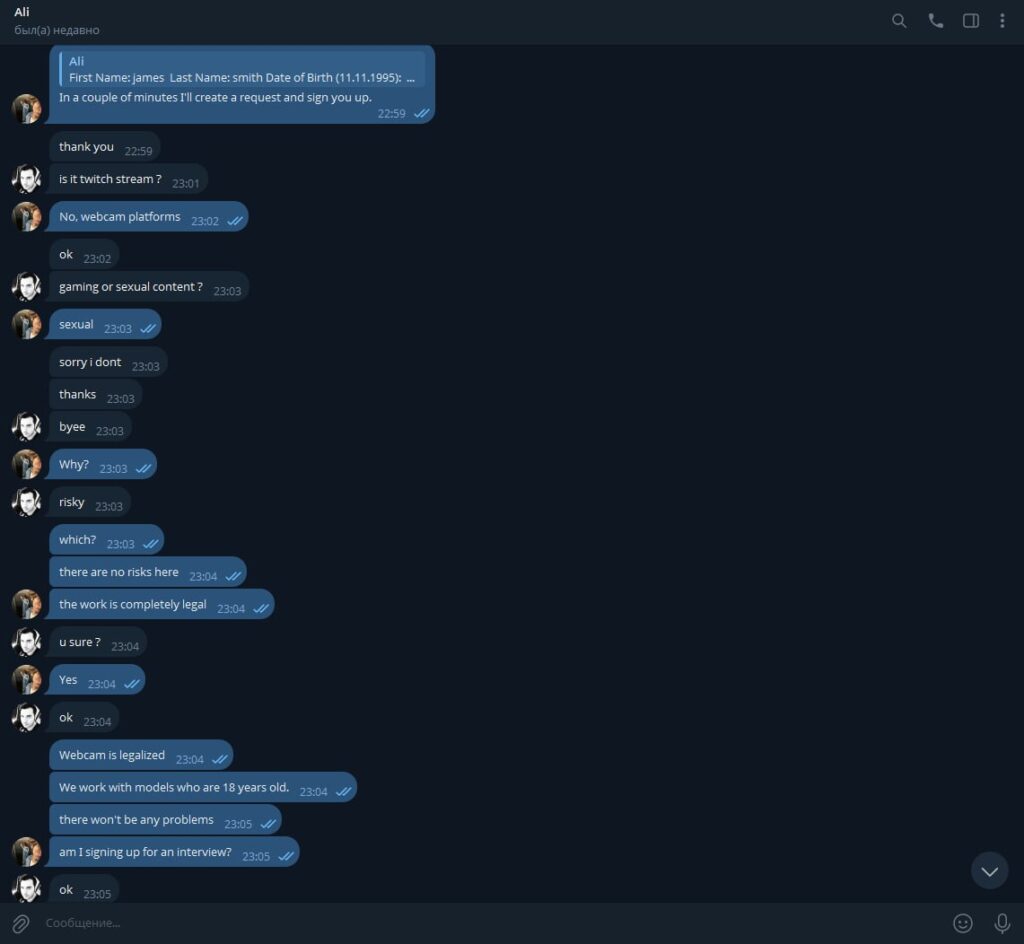
Let the Message Help People Assess Fit
A clear message can allow unsuitable readers to opt out early.
Relevant information about location, language, schedule, responsibilities, or an interview may reduce replies from people for whom the role does not fit. That is not automatically a performance loss.
However, avoid adding arbitrary restrictions. Use the offer’s confirmed requirements rather than assumptions about what a “strong candidate” looks like.
The purpose is to support informed interest, not to reject everyone who asks questions or sounds uncertain.
Find Where the Conversation Loses Momentum
Assess the first message within the candidate outreach funnel:
Delivery or impression → reply or click → detailed explanation → application → contact → interview → confirmed event
Not every platform provides reliable delivery or reading data. Use the measurements actually available.
Different patterns suggest different questions:
| Observed pattern | What to investigate |
| Messages are delivered but rarely receive relevant replies | Relevance, opening wording, sender identity, channel context |
| People reply but leave after receiving details | Whether the opening created different expectations |
| People click but do not apply | Requirements, page clarity, suitability, form experience |
| Applications arrive but contact is unsuccessful | Contact accuracy, process expectations, response timing |
| Interviews are missed | Scheduling, communication, readiness, and other known causes |
These are diagnostic questions, not proof of a single cause.
Analyse the Replies as Well as Their Number
Candidate responses can reveal what the opening leaves unclear.
Repeated “What is this actually about?” questions suggest that the role may be too vague. Repeated surprise about the schedule suggests that an important condition should appear earlier.
Questions about earnings are normal. Their presence alone does not prove that the message attracts unsuitable candidates.
Record recurring misunderstandings and distinguish them from reasonable requests for detail. Move essential information into the opening; keep less common questions in a supporting FAQ.
How to Test Recruiting Messages
You can test the opening sentence, headline, length, CTA, or order of information.
Change one main element when the aim is to understand its effect. If several elements change together, you can compare the complete versions, but you cannot confidently attribute the result to one wording choice.
Use comparable audiences and timing. Avoid sending both variants to the same person in a way that creates duplicate contact.
Consider this hypothetical example:
| Result | Message A | Message B |
| Unique recipients receiving a delivered message | 1,000 | 1,000 |
| Unique recipients replying | 180 | 110 |
| Applications | 70 | 50 |
| Attended interviews | 8 | 19 |
| Reply rate | 18% | 11% |
| Recipient-to-attended-interview conversion | 0.8% | 1.9% |
Message A receives more replies. Message B produces more attended interviews.
That makes Message B worth further investigation. Costs, confirmed payable events, and comparable follow-up are still needed before declaring it the more profitable version.
Also separate positive or relevant replies from requests to stop contact. Counting every response as success can produce a misleading result.
Keep the Tone Human and Follow Up Carefully
Use plain language and a clear explanation. Excessive punctuation, forced familiarity, and vague claims about “unique opportunities” add little useful information.
Do not turn the first contact into a full interview or request unnecessary personal details.
If follow-up is appropriate under the agreed process and the person has not declined contact, a brief clarification may be useful:
“Following up on my message about [role]. The main responsibilities are [brief description]. If it is relevant, the details are here: [link]. If not, I will leave it there.”
Avoid repeated daily messages, “???”, accusations, or invented deadlines. Respect a request to stop.
First Recruiting Message Checklist
Before sending or publishing, check:
- Is your identity and role clear?
- Is the opportunity described accurately?
- Is the context for contact genuine?
- Are important requirements visible?
- Are benefits and earnings claims verified?
- Is the message concise enough for the channel?
- Does the CTA match the actual next step?
- Does the destination continue the same explanation?
- Have you removed invented urgency?
- Can the person decline without pressure?
The strongest first message gives a suitable reader a reason to continue and enough information to decide.
Evaluate it through the full candidate journey. Replies matter, but applications, subsequent participation, confirmed events, and costs show whether the opening supports a useful recruiting funnel.
Explore the available HUNT ME recruiting offers to build messages around the actual requirements of each direction
From here it's just practice
You already know how it works. Sign-up takes a couple of minutes and costs nothing.
No investment. Candidates 18+ only.