To access the HUNTME referral program dashboard, enter the email and password you used during registration.
Fill out the form — it takes 2 minutes. A manager will contact you on Telegram, provide free training, and help you get your first result.

Forget obsessing over perfect targeting settings or overbuilding funnels. In 2026, the real growth lever in performance marketing is creative. Platforms are stricter, competition for attention keeps climbing, and audiences get bored of repetitive ads way faster than they did a few years ago.
If it used to be possible to find one winning video and run it for weeks, that’s rare now. Creatives burn out faster, users see the same message more often, and performance drops as people simply stop reacting.
The advantage today isn’t having one “perfect” ad. It’s having a system that lets you generate new hypotheses quickly, test them without chaos, and keep refreshing ads before the audience checks out. That system is a creative testing matrix—a structured creative testing framework that turns creative production into repeatable output instead of random inspiration.
What an ad creative is actually made of
To use an ad creative matrix properly, you need to understand what you’re combining. Most ad creatives—especially short-form—can be broken into the same core building blocks:
Earn with HUNT ME — weekly payouts
Once these elements are defined, it becomes far easier to create new concepts, remix angles, and generate ad variations fast—because you’re not reinventing the entire ad each time.
A creative testing matrix is a method of breaking creatives into reusable elements and combining them into structured variations.
When you build every ad from scratch, production becomes slow and unpredictable. Each new piece needs a fresh idea, script, edit, and test—so creative output becomes the bottleneck and scaling stalls. A matrix fixes that. It turns creative production into a system: you prepare a set of angles, formats, hooks, proofs, and CTAs, then mix and match them at speed. That becomes an ad creative production workflow you can run weekly—without depending on inspiration.
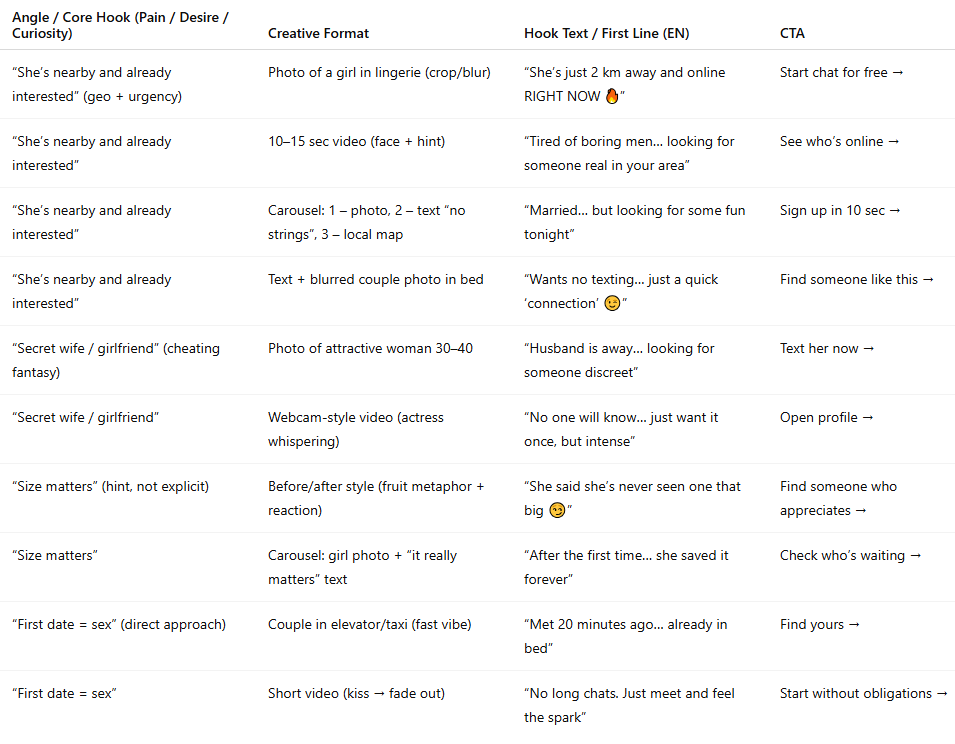
A practical matrix starts with a simple 5×5 structure: angles × formats.
Angles are different lenses for the same offer. For example:
Formats could be:
Five angles × five formats gives you 25 base combinations immediately. And you’re not done. Each combination can be iterated by swapping:
This is how one idea turns into 50 ad creative variations quickly—and why teams using a structured creative iteration strategy can produce dozens of testable creatives in a single work session.
Earn with HUNT ME — weekly payouts
Many teams operate in gray zones because they think that’s the only way. We take a different approach. HUNT ME focuses on HR-style offers and works with partners operating in a legal framework. The goal is helping partners connect creators with streaming platforms through trust, communication, and long-term viewer relationships—no explicit content, no nudity, no risky shortcuts.
Earn $10 for each completed shift. Weekly payouts.
Sign up and claim your first offer in 5 minutes.
Most people don’t run out of ideas—they run out of a system for collecting insights.
The easiest idea source is your audience:
Build a simple “insight library.” Store:
Over time, this becomes:
Instead of copying other ads or repeating one concept with a new background, you adapt one core idea for different segments and formats. That keeps production consistent and speeds up iteration inside your ad creative production workflow.

Once you have volume, testing becomes the real skill.
The most common mistake is changing multiple things at the same time. If you change the hook, format, copy, and visuals all at once, you won’t know what caused the result.
A better approach is controlled testing:
This is A/B testing ad creatives (also called split testing creatives). It’s the cleanest way to identify which elements actually move CTR, CPC, and conversion rates.
Another key rule: don’t mix unrelated hypotheses in the same ad set. If you throw wildly different angles into one bucket, the platform’s algorithm will optimize in ways that make analysis muddy. Treat testing like a ladder:
That’s a scalable creative testing framework you can repeat every week.
Even the best creative eventually stops working. The reason is fatigue:
The warning signs are predictable:
In many niches, you’ll see problems once frequency gets too high (often around 6–8), but it depends on audience size and how aggressively you’re spending.
Sometimes the creative hasn’t “died”—the audience is just too small. You’re saturating the same people. In either case, the fix is the same: refresh the creative systemically.
If you’re wondering how to reduce ad fatigue, the best solutions are structural, not cosmetic:
A small change—like a new opening frame or different edit rhythm—can extend a creative’s life and help with scaling campaigns with new creatives.

Great creative doesn’t matter if it never gets approved.
Most rejections come from:
The simple rule: the ad must accurately match what the user sees after the click. Clear expectations reduce complaints and help approvals hold longer.
AI can absolutely speed things up—especially for:
But full automation is risky. AI output still needs human QA:
The best process is hybrid:
This keeps your creative iteration strategy fast without producing “robot ads.”
When you’re generating 50+ variants, another problem appears: losing control.
If you don’t label and track creatives, you’ll quickly forget what was tested, what worked, and what should be killed. That’s why serious teams run a simple creative table.
Typical columns:
This table helps you see patterns fast:
It also helps you plan output: how many new variants to ship each week, what to re-test, and what to build next.
At that point, your ad creative matrix becomes more than an idea generator—it becomes a creative management system.
Most affiliates chase one “perfect” creative. The teams that scale treat creative like a process.
A creative testing matrix plus a repeatable ad creative production workflow allows you to:
If you’re just starting your journey in traffic and affiliate marketing, join HUNT ME. We’ll provide offers, scripts, guides, and tools—everything you need to build a predictable system instead of relying on luck.
Registration takes 2 minutes. No experience needed — we'll teach you everything.
You just need to fill out the form
Registration takes 2 minutes. No experience needed — we'll teach you everything.